
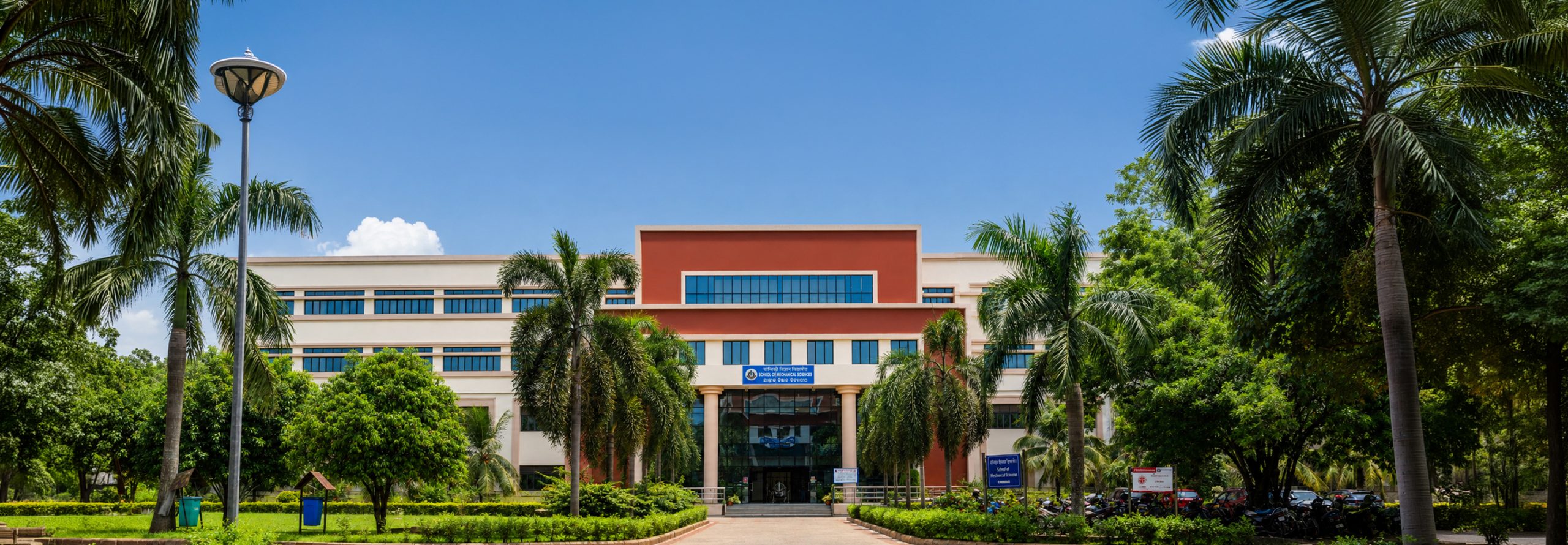
About the Programme
Pursuing a Post-Graduate (PG) in Mechanical Engineering at the School of Mechanical Sciences, IIT Bhubaneswar takes students beyond the fundamentals of engineering into focused, research-driven specialisation. The programme is built to sharpen advanced technical expertise while keeping students connected to interdisciplinary learning, live projects, and the school’s ongoing sponsored research and industrial consultancy work. The curriculum and faculty at the School of Mechanical Sciences are student-friendly, helping scholars sharpen their expertise and pursue their research interests in depth.
The school encourages students to work closely with faculty on problems in design, thermal science, manufacturing, and robotics & AI that carry both technological and societal relevance. Alongside core coursework, students engage in seminars, laboratory work, and a thesis or project that lets them develop conceptual depth in their chosen specialisation. They are encouraged to collaborate across schools and are supported in pursuing startups and entrepreneurial ideas, publications, patents, and innovations, and to contribute to the school’s research culture, building independence, collaboration, and responsibility along the way.
School of Mechanical Sciences at IIT Bhubaneswar offers the following M.Tech. programmes through GATE:
- M.Tech. in Mechanical Systems Design
- M.Tech. in Thermal Science & Engineering
- M.Tech. in Manufacturing Engineering
- M.Tech. in Robotics and Artificial Intelligence
The M.Tech. programme runs for two years (4 semesters), combining core and elective coursework with a thesis or project carried out under faculty guidance. The detailed curriculum is given below.
Indian Applicants: Click here for admission information
International Applicants: Click here for admission information
Curriculum of M.Tech Students
M.Tech in Mechanical System Design
Semester-1
| Subject Name | Code | L-T-P | Credit | Contact Hours |
| Vibrations | ME6L001 | 3-1-0 | 4 | 4 |
| Applied Elasticity | ME6L052 | 3-1-0 | 4 | 4 |
| DE 1 | Elective | 3-0-0 | 3 | 3 |
| DE 2 | Elective | 3-0-0 | 3 | 3 |
| DE 3 | Elective | 3-0-0 | 3 | 3 |
| Mechanical Systems Simulation Laboratory-I | ME6P001 | 0-0-3 | 2 | 3 |
| Vibration Laboratory | New code | 0-0-3 | 2 | 3 |
| Total | 21 | 23 | ||
Semester-2
| Subject Name | Code | L-T-P | Credit | Contact Hours |
| Dynamics and Control of Mechanical Systems | ME6L051 | 3-1-0 | 4 | 4 |
| Advanced Solid Mechanics | ME6L002 | 3-1-0 | 4 | 4 |
| DE 4 | Elective | 3-0-0 | 3 | 3 |
| DE 5 | Elective | 3-0-0 | 3 | 3 |
| Mechanical Systems Simulation Laboratory-II | ME6P003 | 0-0-3 | 2 | 3 |
| Design and Dynamics Laboratory | New code | 0-0-3 | 2 | 3 |
| Total | 18 | 20 | ||
Semester-3
| Subject Name | Code | L-T-P | Credit | Contact Hours |
| Thesis Part – II | ME6D002 | 15 | ||
| Total | 15 | |||
Semester-4
| Subject Name | Code | L-T-P | Credit | Contact Hours |
| Thesis Part – III | ME6D003 | 15 | ||
| Total | 15 | |||
M.Tech in Thermal Science & Engineering
Semester-1
| Subject Name | Code | L-T-P | Credit | Contact Hours |
| Advanced Fluid Dynamics | ME6L101 | 3-1-0 | 4 | 4 |
| Computational Methods in Thermo-Fluids Engineering | ME6L102 | 3-1-0 | 4 | 4 |
| Experimental Techniques for Thermo-fluids | New code | 3-0-0 | 3 | 3 |
| DE 1 | Elective | 3-0-0 | 3 | 3 |
| DE 2 | Elective | 3-0-0 | 3 | 3 |
| Advanced Thermo-fluid Laboratory | New code | 0-0-3 | 2 | 3 |
| Scientific Computing Laboratory | New code | 0-0-3 | 2 | 3 |
| Total | 21 | 23 | ||
Semester-2
| Subject Name | Code | L-T-P | Credit | Contact Hours |
| Advanced Thermodynamics | ME6L105 | 3-0-0 | 3 | 3 |
| Advanced Heat Transfer | ME6L151 | 3-1-0 | 4 | 4 |
| DE 3 | Elective | 3-0-0 | 3 | 3 |
| DE 4 | Elective | 3-0-0 | 3 | 3 |
| Applied Computational Laboratory | New code | 0-0-3 | 2 | 3 |
| Energy Systems Laboratory | New code | 0-0-3 | 2 | 3 |
| Total | 17 | 19 | ||
Semester-3
| Subject Name | Code | L-T-P | Credit | Contact Hours |
| Thesis Part – II | ME6D002 | 15 | ||
| Total | 15 | |||
Semester-4
| Subject Name | Code | L-T-P | Credit | Contact Hours |
| Thesis Part – III | ME6D003 | 15 | ||
| Total | 15 | |||
M.Tech in Manufacturing Engineering
Semester-1
| Subject Name | Code | L-T-P | Credit | Contact Hours |
| Machining Science | ME6L301 | 3-1-0 | 4 | 4 |
| Advanced Manufacturing Processes-I | ME6L302 | 3-1-0 | 4 | 4 |
| DE 1 | 3-0-0 | 3 | 3 | |
| DE 2 | 3-0-0 | 3 | 3 | |
| DE 3 | 3-0-0 | 3 | 3 | |
| Machining Science and Surface Engineering Lab | New code | 0-0-3 | 2 | 3 |
| Advanced Manufacturing Processes Laboratory-I | ME6P351 | 0-0-3 | 2 | 3 |
| Total | 21 | 23 | ||
Semester-2
| Subject Name | Code | L-T-P | Credit | Contact Hours |
| Advanced Manufacturing Processes-II | ME6L303 | 3-1-0 | 4 | 4 |
| Digital Manufacturing | ME6L320 | 3-1-0 | 4 | 4 |
| DE 4 | Elective | 3-0-0 | 3 | 3 |
| DE 5 | Elective | 3-0-0 | 3 | 3 |
| Advanced Manufacturing Processes Laboratory-II | ME6P352 | 0-0-3 | 2 | 3 |
| Manufacturing Simulation Lab | ME6P350 | 0-0-3 | 2 | 3 |
| Total | 18 | 20 | ||
Semester-3
| Subject Name | Code | L-T-P | Credit | Contact Hours |
| Thesis Part – II | ME6D002 | 15 | ||
| Total | 15 | |||
Semester-4
| Subject Name | Code | L-T-P | Credit | Contact Hours |
| Thesis Part – III | ME6D003 | 15 | ||
| Total | 15 | |||
M.Tech in Robotics & AI
Semester-1
| Subject Name | Code | L-T-P | Credit | Contact Hours |
| Robotics | ME6L401 | 3-0-0 | 3 | 3 |
| Artificial Intelligence | New Code | 3-0-0 | 3 | 3 |
| DE 1 | 3-0-0 | 3 | 3 | |
| DE 2 | 3-0-0 | 3 | 3 | |
| DE 3 | 3-0-0 | 3 | 3 | |
| Robotics Design and Synthesis Lab | ME6P450 | 0-0-3 | 2 | 3 |
| Robotics and Programing Lab | New code | 0-0-3 | 2 | 3 |
| Total | 21 | 23 | ||
Semester-2
| Subject Name | Code | L-T-P | Credit | Contact Hours |
| Advanced Robotics and AI | New code | 3-1-0 | 4 | 4 |
| Advanced Mechatronics | New code | 3-0-0 | 3 | 3 |
| DE 4 | Elective | 3-0-0 | 3 | 3 |
| DE 5 | Elective | 3-0-0 | 3 | 3 |
| Robotics and Mechatronics Lab | ME6P452 | 0-0-3 | 2 | 3 |
| Robotics Vision Lab | New code | 0-0-3 | 2 | 3 |
| Total | 17 | 18 | ||
Semester-3
| Subject Name | Code | L-T-P | Credit | Contact Hours |
| Thesis Part – II | ME6D002 | 15 | ||
| Total | 15 | |||
Semester-4
| Subject Name | Code | L-T-P | Credit | Contact Hours |
| Thesis Part – III | ME6D003 | 15 | ||
| Total | 15 | |||
Ph.D
About the Programme
Ph.D. in Mechanical Engineering at the School of Mechanical Sciences, IIT Bhubaneswar is a journey of independent, in-depth research carried out with the close guidance of faculty. The programme is designed to build both research rigour and academic maturity, taking scholars from structured coursework through to an original contribution to the field. Admission is round the year, offered across four windows. The scholars join either the Autumn or Spring session depending on the window they are admitted in.
Every scholar begins with a compulsory course, Introduction to Research and Entrepreneurship, along with at least two courses recommended by their respective Doctoral Advisory Committee (DAC), tailored to the scholar’s specific area of research. Once the coursework is completed, scholars appear for the Qualifying Examination to demonstrate their command over the coursework undertaken. This is followed by the Registration Seminar, where the scholar presents their research objectives and proposed direction of work before the DAC. Research progress is then tracked through periodic DAC review seminars, culminating in the pre-synopsis seminar, thesis submission, and the final open defence (viva-voce).
The school encourages scholars to work closely with faculty on problems in core (thermal science, design, manufacturing, and robotics) or interdisciplinary areas that carry both technological and societal relevance, and are supported in pursuing startups and entrepreneurial ideas, publications, patents, and innovations.
Important Links
- Notice Regarding Admission into the Round Year Advertisement: Click here
- Information Regarding PhD Admission for International Applicants: Click here
- Information on Admission to PhD(QIP) Programme: Please visit the page https://www.iitg.ac.in/cet/qip.html